
Seawall Replacement: what it involves
Replacement means a new structural wall: new sheet piles or panels, new anchors and a new cap. On many Pasco and Hernando canals, the walls built during the 1960s development boom are 50 to 60 years old, and some were weakened further by Helene's surge in 2024. When several panels have cracked through or the wall has lost its anchors along most of its length, repairs stop making sense.
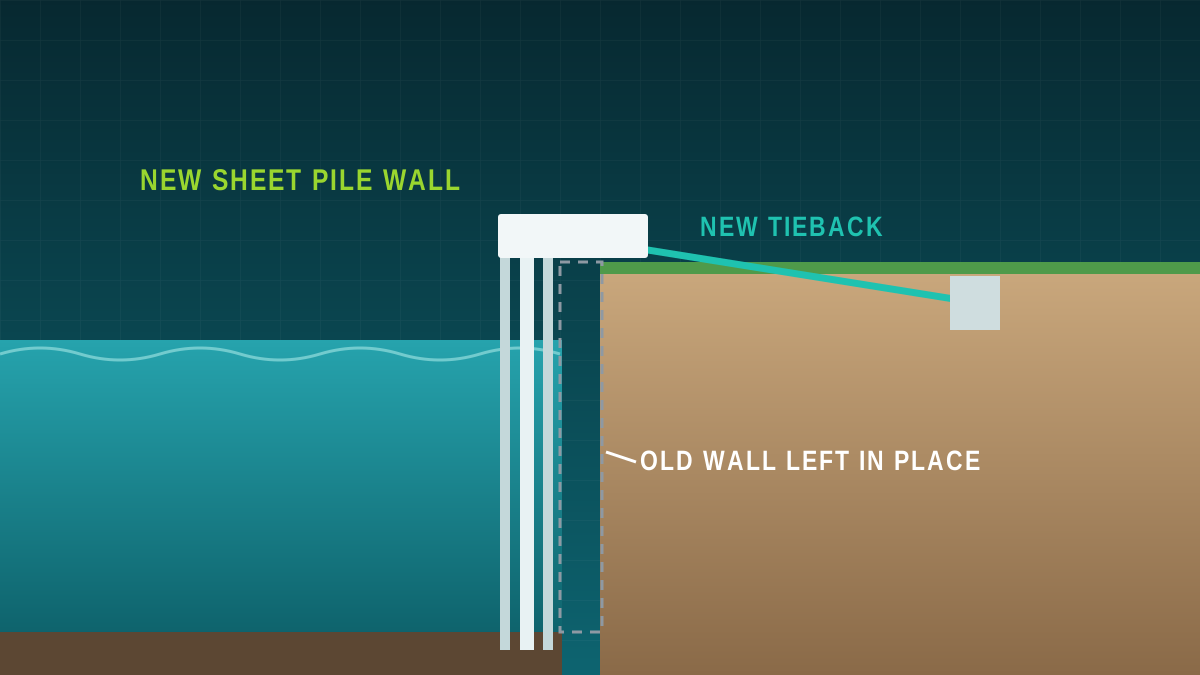
Often the new wall goes in just in front of the old one, so the failed wall can stay in place as backfill. Florida law has a specific rule for this: section 403.813(1)(e) of the Florida Statutes lists restoring a seawall at its previous location, upland of it, or within 18 inches waterward of it among activities that don't need certain state permits. Local building permits still apply.
Signs replacement may be the better choice
- Several panels cracked through or broken
- The wall leans along most of its length, not just one spot
- Repeated repairs on the same wall in recent years
- Large sections of cap gone or dropped
- Repair estimates approaching half the cost of a new wall
Not sure if it's time to replace? A contractor can price both options.
Free EstimateCommon methods
Vinyl or composite sheet pile
Interlocking sheets are driven into the bottom, anchored and capped. They don't rust or spall, and they're common for residential canal walls.
Concrete panels
Precast concrete panels with a poured cap are the traditional canal wall and still common when matching neighbors.
New wall in front of old
A new wall is driven just in front of the failed one and anchored back through it, avoiding the cost and mess of removing the old wall.
Permits for a new wall
Replacement always needs a local building permit, usually with engineered drawings. Depending on where the new wall goes and what's around it, state or federal reviews may also apply. Florida's statute exempts restoration within 18 inches waterward of the old wall from some state permits, but it doesn't replace local permits.
- Law
- Section 403.813(1)(e), Florida Statutes
- Covers
- Restoring a seawall at its previous location, upland of it, or within 18 inches waterward of it
- Still needed
- Local building permit from the city or county office for your parcel
Source: Florida Statutes 403.813 (2025), checked October 2026.
How a replacement project usually goes
- Inspection and surveyThe contractor documents the old wall and often orders a survey of the lot line and water depth.
- EngineeringAn engineer designs the new wall, anchors and cap for your conditions.
- PermitsThe contractor files with the right local office and any state or federal agency needed.
- ConstructionSheet piles or panels are installed, anchored and capped, usually from a barge.
- Backfill and restoreFill is placed behind the wall, compacted and the yard is put back.
Ask whether the new wall will go in front of the old one and how far.
What replacement costs
LatestCost's 2026 figures put Florida seawall replacement at about $500 to $1,200 per linear foot, depending on material, height and access. HomeAdvisor reports an average of about $25,000 for a seawall, with typical projects from $15,000 to $60,000.
Reference figure, not a quote: LatestCost, Florida seawall replacement (2026), checked October 2026.
Get a replacement price and a repair price side by side.
Free EstimateWhere replacement is most common
- Gulf HarborsOriginal canal walls after Helene
- Hernando Beach60-year-old walls on long lots
- HudsonOldest walls near the inlets
- Pine IslandOpen-Gulf walls after Idalia and Helene
- AripekaShort, aging walls on Hammock Creek
- BayportExposed walls at the river mouth
Related services: Leaning Seawall & Tieback Repair, Seawall Height Raise, Seawall Inspections.
Seawall Replacement questions
How long does a new seawall last?
It depends on the material and conditions. Ask each contractor what life to expect from the material they propose and what the warranty covers.
Does the old wall have to be removed?
Often not. A new wall can be installed just in front of it, which Florida law allows within 18 inches waterward without certain state permits.
Do I need an engineer?
Most replacements need engineered drawings for the building permit. Your contractor usually arranges it.